In most private label diaper projects, packaging is treated as the last step: choose a bag, drop the artwork on it, and move on. That habit costs you money twice. The bag format decides how many units fit in a carton, how many cartons fit in a container, and how the product reads on a shelf next to Pampers, Huggies and local leaders. The carton and pallet decisions decide whether your landed cost per piece comes in at the number your margin model assumes or 8–12% higher.
This guide breaks packaging into four layers — bag format, carton configuration, container loading and market compliance — so you can decide packaging deliberately rather than as a printing afterthought. It is written for brand owners and procurement teams running private label baby diaper programs. Planning a private label baby diaper program? Explore our Baby Care products to learn more about our OEM and private label options for your target market.
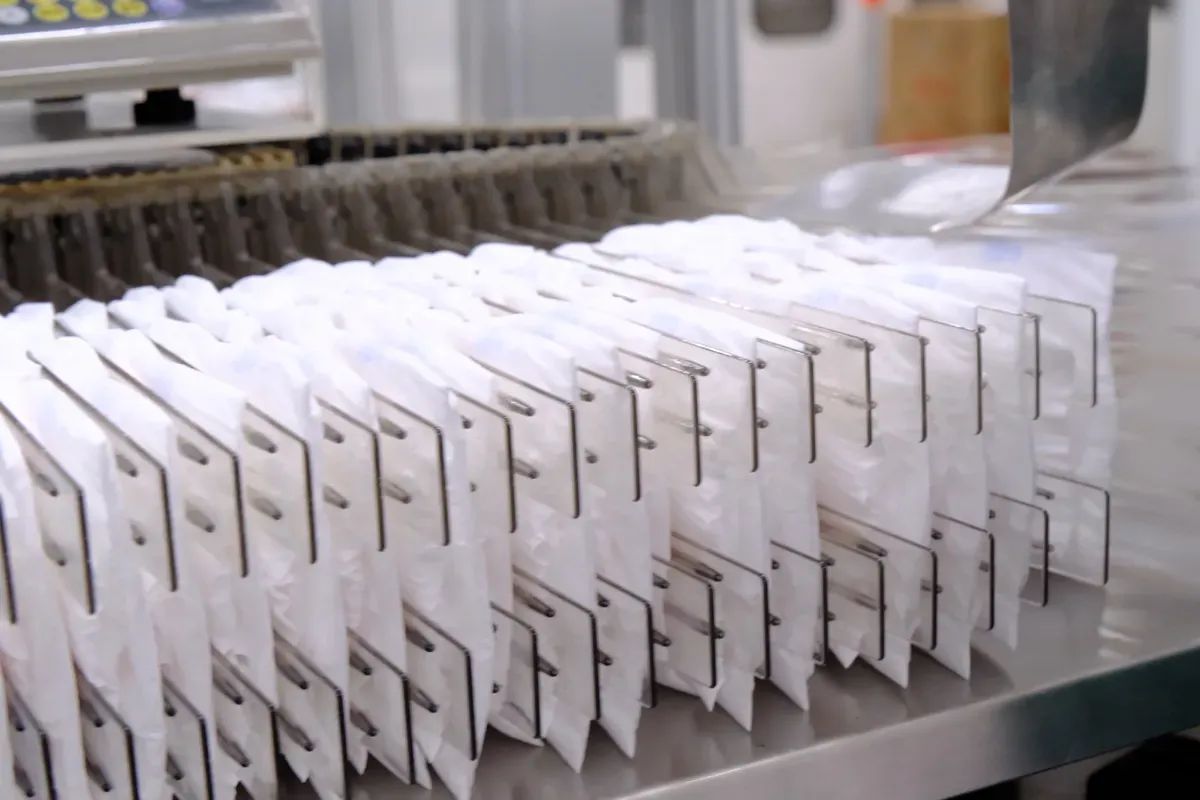
Why Packaging Deserves Its Own Decision
Packaging is not a finishing detail. Across a typical private label diaper program, packaging (film bag + printed carton + pallet wrap) accounts for a meaningful share of landed product cost — commonly in the low double digits as a percentage of FOB unit price, with the exact share depending on pack count, film grade and bag format.
The more important number is the cost of getting it wrong. A bag that cannot run on the supplier's existing form-fill-seal line triggers new tooling and a delay. A carton that collapses in a tropical transshipment port generates chargebacks. A label missing a mandated language or importer address can hold a shipment at customs. Each of these rework events costs far more than the few cents saved by choosing the cheapest film grade. Packaging is a decision, not an execution step.
Bag Formats Explained: Poly, Box, Soft Pack, Compressed
Four bag formats dominate the baby diaper private label market. Each has a different cost position, shelf behavior and logistics implication.
| Format | Best for | Cost position | Shelf / logistics note |
| Poly bag (stand-up) | Mass-market supermarkets, value channels | Lowest bag cost; fastest line speed | Standard hanger hole; bulky in carton; familiar to shoppers |
| Boxed (carton) | Premium gifting, maternity wards, online subscriptions | Highest per-unit packaging cost; more tooling | Strong shelf presence; protects product well; heavier to ship |
| Soft pack | Mid-to-premium retail, pharmacy channels | Mid; softer film with better print feel | Slimmer profile; easier to stack; resealable zipper common |
| Compressed pack | E-commerce, dense urban markets, export volumes | Slightly higher film cost; lower freight per piece | Flat vacuum-sealed bag; 30–50% more units per container |
The compressed pack is the format buyers most often overlook. It costs a little more per bag but reduces freight so sharply that it usually wins on landed cost, especially for sea-freight programs to North America, Europe and the Middle East.
Film Structure and Printing Options
Diaper bags are laminated films, usually three layers: a printed outer layer, a barrier middle layer that protects product integrity, and a heat-seal inner layer that closes the bag on the packaging line. The printed layer carries your artwork; the barrier layer controls moisture and oxygen; the seal layer must bond reliably at high line speed. Changing any layer changes both the cost and the MOQ.
For printing, gravure delivers long runs with consistent color and a smoother finish, but requires engraved cylinders (one per color) and a higher setup fee. Flexo is cheaper for short runs and faster to change, with slightly lower print resolution. Color count matters: each extra color adds cylinder cost and extends proofing lead time.
At Easy Hygienic, we coordinate with our approved film suppliers so that film structure, engraving and sampling are handled in one pipeline — you do not need to carry specifications back and forth between a packaging converter and the diaper factory. Contact Easy Hygienic to discuss your artwork requirements, preferred packaging format and the next steps for your OEM project.
Pack Count and Shelf Logic
Pack count — the number of diapers per retail bag — looks like a marketing choice, but it is the lever that pulls most of your unit economics. A smaller pack (e.g. 24 pieces in size M) looks cheaper on the shelf, supports trial purchase and suits dense urban retail where shelf space is expensive.
A larger pack (e.g. 56 pieces) lowers the per-piece packaging and freight cost, but raises the entry price and requires deeper shelf depth. E-commerce programs often use a third pack size tuned to courier volumetric weight tiers.
Pick pack counts against your channel: one for the shelf, one for online, one for maternity or gift. Forcing a single pack count across all channels usually means you are leaving margin on the table in at least one of them.
Carton and Pallet Configuration
The export carton is not a storage box; it is a logistics instrument. Three numbers drive it: pieces per carton, carton burst strength (measured in kPa or lb/in²), and pallet stacking height.
Pieces per carton should divide cleanly into your retail pack count so that distribution centers can pick without opening inner packs. Burst strength is chosen for the route: a Singapore domestic move needs less protection than a Rotterdam-to-inland-truck leg through humid conditions.
Pallet height is set by container internal clearance and by warehouse racking limits at the destination. Add desiccant or a moisture barrier for sea routes that cross equatorial zones; without it, film bags can soften and cartons can warp by the time the container is unpacked.
Packaging is only one part of evaluating a manufacturing partner. For a broader sourcing checklist, see our guide to choosing a baby diaper manufacturer.
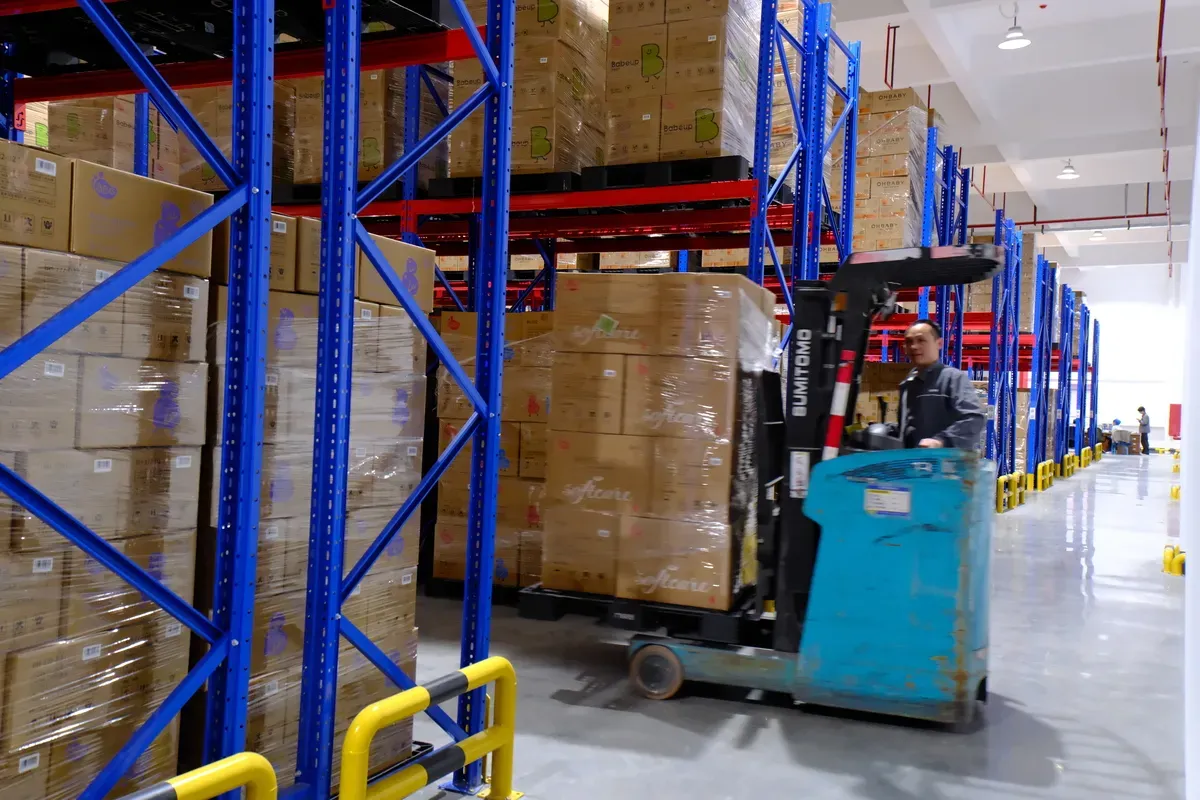
Container Loading: The Math Buyers Forget
Diapers are light but bulky. A carton of diapers may weigh 8–12 kg but occupy 0.06–0.09 CBM. In shipping terms, the freight cost is driven by volume, not by weight — this is why compressed packaging changes the economics so much.
A non-compressed stand-up pack leaves void space inside the carton; a vacuum-compressed pack fills nearly the same carton with 30–50% more pieces.
The estimation method is straightforward: take the carton dimensions, multiply by units per carton, divide into the usable CBM of a 20ft or 40HQ container (typically around 28 CBM and 67 CBM respectively after dunnage), and confirm the pallet footprints fit the container door.
Buyers who only compare per-piece FOB price often miss that the compressed format lands 10–15% cheaper per piece even at a higher bag cost.
Labeling and Compliance by Market
Label requirements are not a single global spec. They differ by destination, and a bag designed for one market can usually not be resold in another without rework.
Across the major markets, expect to show: product size and weight range, piece count, batch/lot number, production and expiry dates (where required), importer or responsible-person name and address, fiber or material declarations where applicable, and safety warnings.
Language requirements vary: the EU requires the official language(s) of each member state of destination; the UK follows English with Northern Ireland provisions; the US uses English and Spanish is commonly expected; Canada requires bilingual English and French; Japan and Korea require local-language labeling with importer registration information.
Barcodes (EAN/UPC) must match the pack count and size — a single artwork reused across sizes will fail barcode scanning at retail. Confirm the current requirements with your importer or regulatory consultant before final artwork, since these rules are revised periodically.
Cost Impact Breakdown
The table below summarizes how each packaging decision moves unit price and MOQ. Direction matters more than absolute numbers, which are quoted per project.
| Decision | Effect on unit price | Effect on MOQ |
| Thicker / barrier film | Higher bag cost; better shelf life | Usually unchanged |
| Gravure, more colors | Higher setup; better long-run print cost | Higher MOQ per color/design |
| Flexo, fewer colors | Lower setup; slightly higher per-piece at volume | Lower MOQ suitable for test orders |
| Box vs poly bag | Box raises per-unit packaging costBox tooling raises first-order MOQ | Box tooling raises first-order MOQ |
| Compressed pack | Slightly higher bag; lower freight per piece | Similar MOQ; format-specific tooling |
| Resealable zipper | Adds bag cost; supports premium pricing | Minor line-setup impact |
Artwork Timeline and Approval Flow
Packaging development follows a fixed sequence, and skipping a stage is where delays originate.
First, final dieline and artwork are approved in PDF.
Second, the film supplier produces a printed proof (a short press run on the actual film).
Third, you sign off on the physical proof — color, barcodes, zipper function, hanger hole position.
Fourth, mass production starts once the signed sample is locked.
Typical end-to-end time runs from roughly two to four weeks for a flexo short-run project, and four to six weeks for gravure with multiple colors, depending on color corrections and any language revisions.
The most common bottleneck is artwork revision after the press proof: every round of color or copy change adds days. Lock artwork text and regulatory copy before the proof run.
Diaper Packaging FAQ
What is the MOQ for custom printed diaper bags?
The MOQ depends on the printing process and the number of colors, not on a universal number. Flexo short-run projects can support lower per-artwork volumes for test orders; gravure long runs require more bags per design to amortize cylinder cost. Multi-size programs that share an artwork can often consolidate across sizes, but each size with its own barcode and pack count is treated as a separate print. To help us assess your project, share your target market, diaper sizes, desired pack counts and estimated order volume. Our team can then discuss suitable packaging options and the next steps for your private label program. Contact us to discuss your requirements.
Can I use the same artwork across sizes?
Visually it is possible, but operationally it is usually a mistake. Each size needs its own printed size marking, weight range, piece count and barcode. If you try to run one master artwork with stickers for size changes, retail barcode scanners will reject mixed codes and warehouse systems will mis-pick. Plan a separate dieline and plate per size, even when the visual design stays consistent.
How long does packaging development take?
For a standard private label project, expect roughly two to four weeks from artwork approval to signed press proof on flexo, and four to six weeks on gravure with more colors. Add time if you need multiple language versions, if regulatory copy requires your importer's legal review, or if you are trialing a new format such as compressed packs. We share a milestone schedule at quotation so you can plan launch around it.
Conclusion
The key to planning private label diaper packaging is to define the bag format and carton configuration before finalizing artwork and print details. These decisions can affect packaging costs, shipping efficiency and product presentation.
Planning your own private label baby diaper program? Contact Easy Hygienic to discuss your OEM project, including packaging options, artwork requirements and production planning. Share your target markets, diaper sizes and preferred pack counts to help our team understand your requirements and discuss the next steps.