For private label buyers sourcing OEM baby diapers, a quick search for a standard baby diaper size chart may feel like a logical first step. After all, size labels like NB, S, M, and L are universally recognized by consumers. What many new buyers overlook, however, is that there is no global industry standard for baby diaper sizing. Weight ranges, physical dimensions, and fit characteristics can vary dramatically between brands, product lines, and regional markets. Relying on generic size data often leads to misaligned fit, increased leakage complaints, and avoidable product returns once your line launches.
For OEM baby diaper programs, accurate sizing requires structured product specifications tailored to your brand and target market. As part of a broader OEM baby diapers development project, sizing decisions need to align with the product format, performance requirements, and intended users. At Easy Hygienic, we work with buyers to define weight ranges, core dimensions, and fit parameters for their target markets and product positioning. This guide explains how to establish practical sizing and fit specifications for custom baby diaper projects, beyond basic size labels.
How Baby Diaper Sizes Are Usually Defined
Across the global baby diaper market, sizes are almost universally labeled using alphabetic codes, most commonly newborn (NB), small (S), medium (M), large (L), extra large (XL), and in some markets, extra-extra large (XXL) or even preemie sizes for premature infants. This standardized naming system helps consumers navigate shelves and select products based on their child’s age and development.
The primary reference point for every size label is a recommended weight range. Weight is the most accessible metric for caregivers, so nearly every baby diaper size chart leads with weight bands to guide purchase decisions. For example, a typical medium size might be marketed for babies between 6 and 11 kilograms, while a large size might cover 9 to 14 kilograms.
Crucially, though, these weight ranges are not standardized. Two competing brands can both sell a“medium”diaper with overlapping but different weight ranges, and very different internal dimensions. For OEM buyers, understanding this naming convention is the starting point for sizing—but it should never be the only reference. Building a strong private label line requires defining your own size profile, not copying a generic chart.

Why Weight Range Is Not the Only Size Parameter
Weight range works as a helpful consumer guide, but it is a poor predictor of actual baby diaper fit on its own. The reason is simple: babies of the same weight can have very different body shapes. Some carry more weight around the abdomen, others have thicker thighs, and some have longer torsos. A diaper that fits one 8 kg baby perfectly may gap at the waist or squeeze the legs on another.
Beyond body shape, several other factors make weight alone insufficient for sizing. Activity level is a major one: active toddlers who crawl, walk, and run require a closer, more secure fit than newborns who lie down most of the day. Product use case also matters: overnight diapers often have a slightly roomier fit to accommodate thicker, more absorbent cores, while everyday lightweight diapers may be cut slimmer for discretion under clothing.
Consumer preferences also shift by market. In some regions, caregivers prefer a looser, more comfortable fit for daytime use, while others prioritize a snug, secure fit to prevent leaks. For OEM baby diaper sizing, ignoring these factors and sizing only by weight will almost always result in fit issues and customer dissatisfaction.
Key Physical Dimensions for OEM Buyers
To move beyond basic size labels, OEM buyers need to define core baby diaper dimensions for every SKU. These physical measurements form the backbone of OEM diaper specifications and ensure consistent fit across production batches. The key dimensions to specify include:
Unfolded product length: Measured from the top of the front waistband to the top of the back waistband when laid flat. This determines front and back coverage, and directly impacts back leakage protection. Longer diapers offer more rear coverage, which is especially important for overnight and newborn sizes.
Center panel width: The width of the diaper at its narrowest point, between the leg openings. This dimension influences how the diaper sits between the legs and affects both comfort and side leak protection.
Resting waist circumference: The waistband measurement in its natural, unstretched state. This sets the baseline fit for babies at the lower end of the weight range.
Leg opening circumference: The inner measurement of each leg cuff at rest. This must be calibrated to target thigh sizes in your market to create a secure seal without restricting movement.
Absorbent core length and width: The dimensions of the internal absorbent core. Core size directly impacts total absorbency, liquid distribution, and the overall shape of the diaper. It must be proportional to the outer diaper dimensions to ensure even performance across sizes.

Defining these dimensions upfront gives manufacturers clear engineering targets and removes ambiguity from the sizing process.
Waist, Leg and Elastic Fit Parameters
Physical dimensions set the shape of the diaper, but diaper elastic components determine how it actually fits on a moving baby. These fit parameters are among the most overlooked specifications in initial OEM inquiries, yet they are the leading cause of fit-related leakage and comfort complaints.
Key waist and leg fit parameters to define include:
Waistband stretch ratio: The ratio of the waistband’s maximum stretched circumference to its resting circumference. A higher stretch ratio allows for more growth room and a wider fit range, but too much stretch can reduce support and cause sagging. Typical ratios vary by product type and market preference.
Leg cuff height: The height of the standing leg cuffs (also called leak guards). Taller cuffs provide better side leak protection, especially for active babies, but must be soft enough not to irritate inner thighs.
Elastic strand count and tension: The number of individual elastic threads in the waist and leg cuffs, and their tension level. The number, placement, and tension of elastic strands work together to influence fit, pressure distribution, and recovery. The appropriate configuration depends on the product design, materials, and intended fit.
Elastic recovery rate: A measure of how well the elastic returns to its original shape after stretching. High recovery rate ensures the diaper stays snug after hours of wear, even with repeated movement.
Fastening tape adjustment range: For tape diapers, the vertical and horizontal range of positions where the tapes can securely fasten to the frontal landing zone. A wider adjustment range accommodates more body shapes and extends the usable life of each size.
Together, these parameters define the feel and performance of baby diaper fit, and should be tailored to your target market’s body type and comfort expectations.
How Absorbency Changes Across Sizes
Baby diaper absorbency is closely linked to size, but it does not scale proportionally with diaper dimensions alone. Each size requires a purpose-built core configuration that balances absorbent capacity, fit, and comfort for that specific weight range and use case.
In general, larger diaper sizes require higher total absorbent capacity, as older babies produce larger volumes of urine and wear diapers for longer periods between changes. However, simply scaling up a small core to fit a larger diaper would result in poor fit, stiffness, and uneven liquid distribution. Instead, core length, width, SAP-to-fluff pulp ratio, and core structure are all reengineered for each size.
For example, some newborn diaper designs incorporate a contoured or recessed front waist area to accommodate the umbilical stump. Core dimensions and absorbency should be selected according to the product design, intended use, and performance requirements. Overnight size L diapers, by contrast, have longer, wider cores with higher SAP content for maximum overnight capacity, and are shaped to distribute liquid evenly across the full core area.
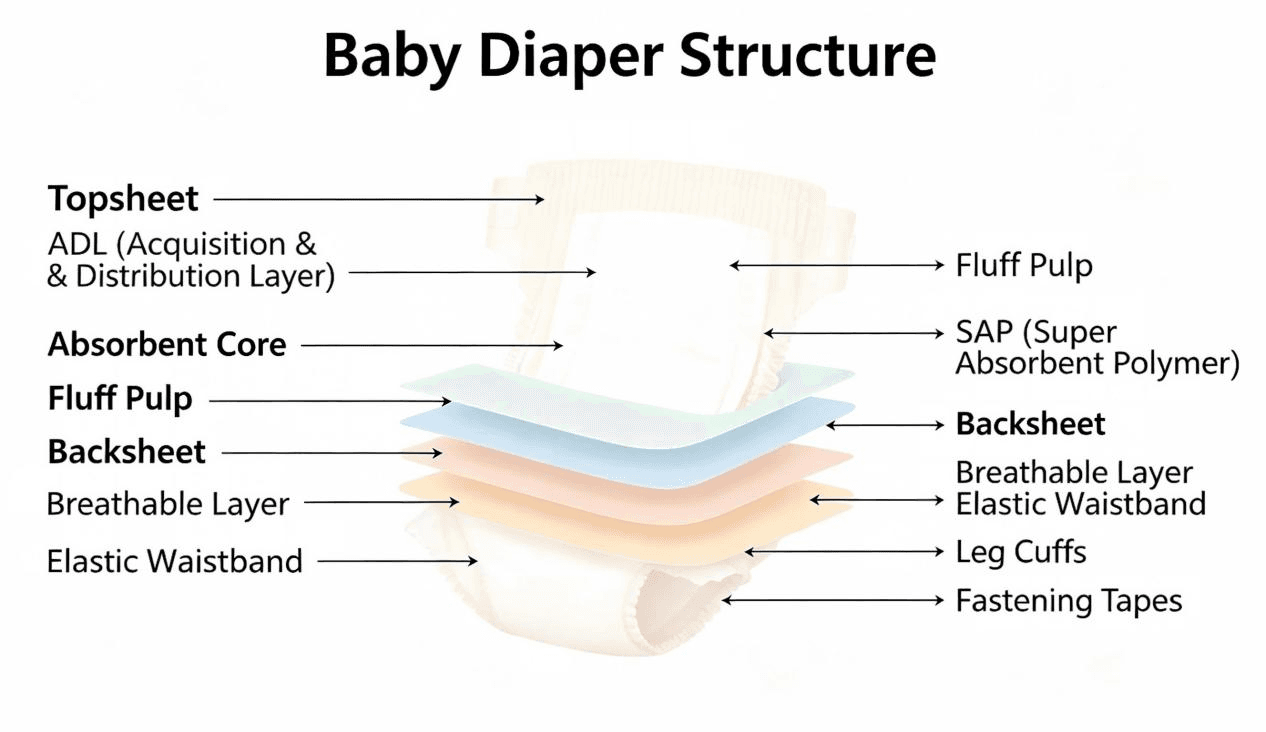
For OEM buyers, it is important to link absorbency requirements directly to size specifications, rather than treating them as separate features. This ensures that every size delivers consistent performance relative to its intended use.
Tape Diaper vs. Pull-Up Pant Sizing
When defining OEM diaper sizes, it is important to recognize that tape diaper size and pull-up pants size follow very different design principles, even when they carry the same size label and weight range.
Tape diapers are designed with an open structure that fastens with adhesive or hook-and-loop tapes at the waist. Most have semi-elastic or fully elastic waistbands that allow for a wide range of adjustability. Because the fit can be customized at every change, tape diaper sizing has more tolerance, and weight ranges can be broader. Measurements are typically specified in the flat, unfolded state.
Pull-up pants, by contrast, are pant-style diapers that pull on like underwear, with a full 360° elastic waistband and no adjustable tapes. This means fit is fixed at the time of manufacture, with no room for adjustment after purchase. Pull-up pants sizing therefore requires much higher precision, with tighter tolerances on waist and leg circumferences. Measurements are often specified in both resting and stretched states to ensure a secure, comfortable fit for active toddlers.
Leg opening shapes also differ: tape diapers generally have wider, more open leg cuts for easier changing, while pull-up pants have closer-fitting leg openings that move with the child’s body during walking and running.
Regional and Brand-Specific Sizing Considerations
There is no such thing as a universal baby diaper size guide that works for every market. Sizing norms, weight bands, and fit expectations vary significantly by region, and successful private label baby diapers adapt to local market realities.
For example, North American markets typically have higher upper weight limits for each size, reflecting population growth patterns and consumer preference for longer use per size. European markets often prioritize a closer, more tailored fit with narrower weight bands. Many Asian markets lean toward slimmer, more lightweight diaper designs with size proportions calibrated to local infant body types.
Size naming conventions also vary. Some markets include XXS or preemie sizes for newborns, while others extend the range up to XXXL for older toddlers. Even the definition of “newborn” can shift, with some markets using NB for up to 5 kg and others up to 6 kg.
For OEM buyers, this regional variation is an opportunity, not a barrier. Customizing your size profile to match your target market allows you to create a better fitting product than generic global brands, and build stronger brand loyalty as a result.
How to Validate Baby Diaper Fit Before Bulk Production
Even the most carefully calculated size specifications need real-world validation before mass production. Baby diaper sample testing is a critical step in the OEM process, and it should evaluate both static and dynamic fit performance.
Static fit testing evaluates how the diaper fits on a stationary mannequin or test form sized to match your target weight range. Testers check for even waist tension, proper leg cuff seal, no gaps at the back or sides, and appropriate core positioning. This confirms that the base dimensions are correct for the target body type.
Dynamic fit testing goes further, simulating real-world movement such as crawling, sitting, standing, and walking. Testers observe whether the diaper stays in place, whether the leg cuffs maintain their seal, and if any sagging or shifting occurs. Movement can affect diaper positioning and the seal around the legs and waist, making dynamic testing an important part of fit validation, especially for active toddler sizes.

Additional checks include pressure testing to identify areas that could cause red marks or discomfort, and leakage testing under movement conditions to confirm the fit supports leak protection. For OEM baby diaper projects, completing this validation before locking in specifications prevents costly rework and reduces post-launch quality issues.
How Easy Hygienic Approaches OEM Size Development
For private label projects, baby diaper sizing is one part of a broader product development process. Easy Hygienic works with buyers to develop market-aligned specifications rather than relying on a single size template for every project. Buyers exploring OEM baby diapers can also review our Baby Care product range to understand the broader product development options available for their brands.
Our size development process starts with discovery: we learn about your target market, brand positioning, product format (tape diaper or pull-up pant), and intended use case (everyday, overnight, newborn). We draw on our global market database of infant body measurements and fit preferences to establish baseline parameters.
Next, our engineering team translates those requirements into full dimensional and fit specifications, including all core dimensions, elastic parameters, and absorbency configurations. We then produce initial prototype samples for internal testing and validation.
Once internal testing confirms performance meets specifications, we submit samples for your review and feedback. We iterate on fit, dimensions, and feel until the product matches your expectations, then lock in all specifications for mass production. This approach ensures that your baby diaper sizing is accurate, market-appropriate, and consistent across every production batch.
FAQ
Q: How are baby diaper sizes defined?
A: Baby diaper sizes are typically defined by alphabetic size codes (NB, S, M, L, XL, etc.) paired with recommended weight ranges for consumers. However, there is no universal industry standard, so actual dimensions and fit characteristics vary widely between manufacturers and markets. For OEM projects, sizing is built from custom specifications based on target market data and brand requirements.
Q: Does baby diaper size depend only on weight?
A: No. Weight range is a useful reference for shoppers, but baby diaper fit depends on many additional factors including body shape, waist and thigh circumference, activity level, and product design. Sizing based solely on weight often leads to poor fit, discomfort, and increased leakage risk.
Q: Can OEM buyers customize diaper sizes?
A: Yes. Private label baby diaper sizes can be fully customized to align with your target market, brand positioning, and performance goals. At Easy Hygienic, we tailor every dimension, elastic parameter, and core configuration to your exact specifications, rather than forcing pre-set size templates.
Q: What should buyers check when testing diaper fit?
A: When evaluating baby diaper fit, check for snug but comfortable waist tension without red marks, a secure leg cuff seal against the skin, no gaps along the back or sides, and no sagging or shifting during movement. At Easy Hygienic, our sample testing process includes both static and dynamic fit assessments to validate performance before bulk production.
Conclusion
Developing accurate baby diaper sizing for OEM and private label products goes far beyond selecting labels from a generic baby diaper size chart. Optimal fit and performance are achieved when weight ranges, precise physical dimensions, and engineered elastic parameters are defined together and validated through real-world testing.
Taking the time to build structured, market-specific size specifications reduces miscommunication with manufacturers, cuts sample revision cycles, and results in a final product that delivers consistent fit, leak protection, and comfort. For long-term success in baby care, prioritizing custom size development is one of the most impactful investments you can make in your OEM baby diaper line.
If you are planning a private label diaper project and need support defining size and fit specifications, contact Easy Hygienic today. Our engineering and product teams will work with you to build a custom sizing profile tailored to your market and brand, and deliver accurate, representative samples to validate performance before production.