
Daytime and overnight adult diapers are often treated as the same product with two absorbency levels. In practice, the difference runs through the whole specification: how long the product stays on, how much the wearer moves, how a reclining or side-lying body loads the core, and what the closure has to withstand before it is changed. A product that performs well through an active day may still be the wrong build for a night in bed, and the reverse holds equally.
This article looks at daytime adult diapers and overnight adult diapers as two specification targets rather than two grades of one design. It compares absorbency planning, core construction, leakage design, comfort and testing, so buyers can define a range that matches real use. For brands looking for a reliable adult diaper manufacturer in China, understanding product specifications is an important first step in developing a competitive private label range.

Understanding the Different Requirements of Daytime and Overnight Use
The two use conditions differ in ways that reach into product structure, not just capacity. Daytime use involves repeated movement — walking, sitting, standing, bending — and a product that shifts or bunches under those movements creates both discomfort and leakage risk. Changes during the day are usually more frequent, and discretion under clothing is part of the buying decision.
Overnight use is static but demanding in a different way. A wearer may lie in one position for hours, and a change is usually completed by someone else. Liquid accumulates in one region of the core, gravity distributes it along whatever path the body position allows, and the product must hold that volume without pressure release at the surface. Daytime versus overnight adult diapers therefore differ in core geometry, containment design and closure strength as much as in absorbency.
Absorbency Requirements for Daytime and Overnight Products
Absorbency planning starts from the change interval the product is designed for, then separates into four measurable behaviours that must be specified individually.
Absorption Capacity
Capacity is the total volume the core can hold, and it is the figure most often quoted in isolation. For overnight products, capacity should be specified in terms of retention under load as well as free capacity, because a reclining body compresses the saturated core continuously. For daytime products, capacity can be sized to the intended change interval without chasing the highest available value, since excess capacity usually arrives with thickness and cost.
Absorption Speed
Speed matters more in daytime use, where a wearer may be seated or moving when urination occurs and a slow surface clearance is felt immediately. Overnight use tolerates a slightly slower first uptake if distribution and retention are strong, because there is time before the next change and no movement to create friction at the surface.
Liquid Distribution
Distribution decides how much of the core is actually used. A daytime core should spread liquid along the length so that a seated wearer does not concentrate flow in one area. An overnight core needs distribution that works when the body is horizontal or side-lying, which places different demands on the acquisition layer and the pulp network inside the core.
Rewet Performance
Rewet is the liquid that returns to the surface under pressure, and it is the metric most closely tied to skin condition during long wear. Overnight products should be specified with rewet measured under sustained load, since the wearer's body weight rests on the product for hours. Daytime rewet accepts a shorter, lighter loading profile but must still hold under sitting pressure. For more details, see our guide to adult diaper size and absorbency levels.
Absorbent Core Design and Material Configuration
Adult diaper absorbent core design balances three variables: total capacity, retention under load and thickness. Adding SAP raises capacity per gram and improves retention, but too high a share can slow first uptake and create a firmer, thicker core. Increasing fluff pulp improves speed and spread while adding bulk and reducing capacity per unit weight.
For overnight products, the usual direction is a longer and wider core with a higher SAP share and a stronger acquisition layer, so liquid is captured where it arrives and held under sustained compression. For daytime products, a shorter, contoured core with a moderate SAP-pulp balance keeps the silhouette low and the product flexible. Core weight, thickness and coverage area therefore belong in the specification as separate parameters, and each one carries a cost consequence that the buyer should see stated rather than inferred.
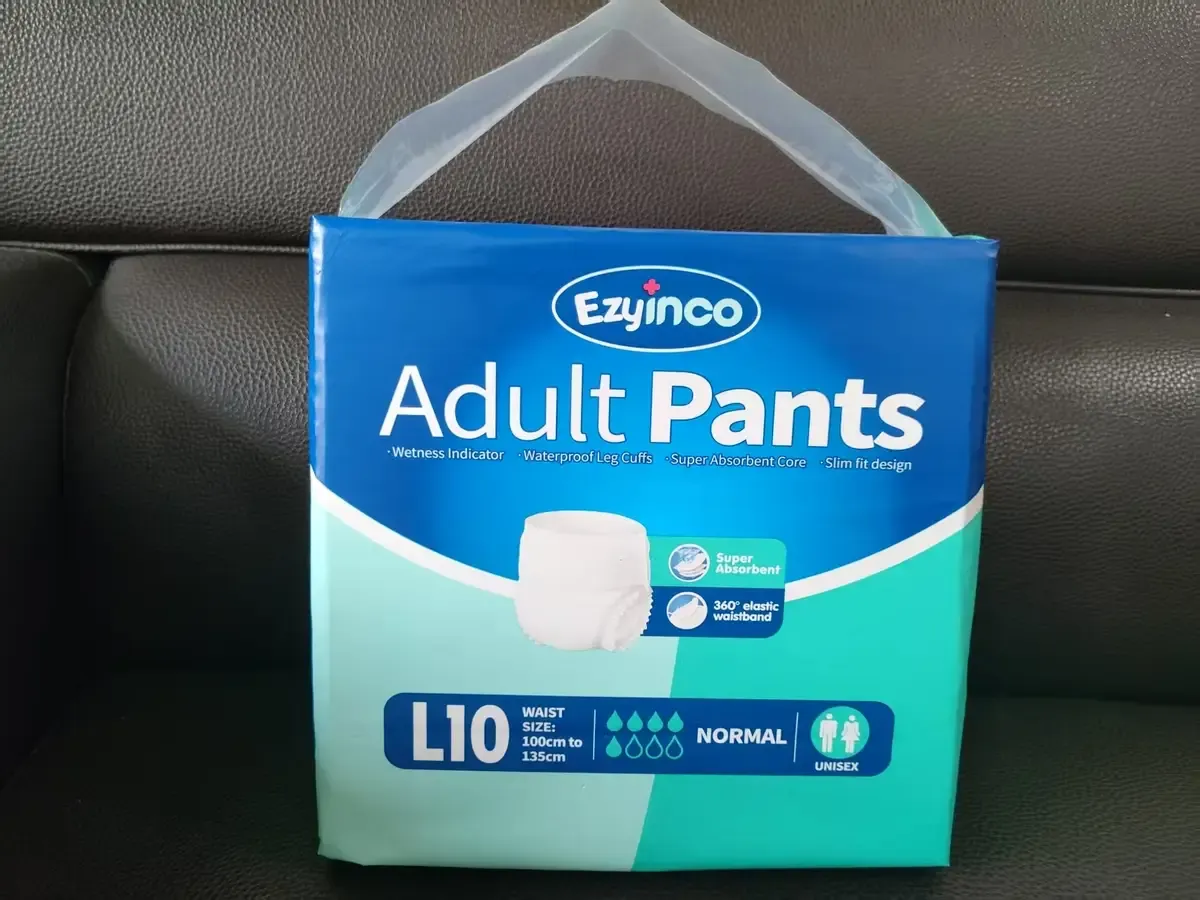
For a closer look at the materials and production stages involved, read our guide to the adult diaper manufacturing process.
Leakage Protection: Key Differences in Product Design
Containment is where the two products diverge most visibly. Daytime leakage usually starts at the leg opening during movement: a cuff that lifts, gaps when the wearer sits, or loses tension after repeated flexing. Design attention goes to cuff height that follows the leg line, elastic tension that recovers, and a waistband that keeps the product anchored while the body moves.
Overnight adult diaper leakage protection has to answer a different failure. When the wearer lies on one side, liquid migrates laterally before the core absorbs it, and gravity keeps it against the leg opening. Taller standing leak guards, hydrophobic cuff material and a core that extends further toward the waist and the back all reduce that path. Front and rear coverage also matter, because a product that is short at the waist leaves a gap when the body turns. A high-capacity core does not compensate for a weak barrier in either case.
Comfort, Breathability and Fit
Adult diaper comfort is a balance rather than a single property. Top sheet softness and low friction matter in both products, but daytime wear adds movement, so breathable adult diapers reduce humidity build-up under clothing during activity. Overnight wear adds duration, so surface dryness and sustained breathability carry more weight than initial hand-feel.
Thickness trades against discretion and against capacity. A thicker core supports longer wear and higher retention, at the cost of silhouette and flexibility. Waistband elasticity should hold without concentrating pressure: a wide elastic zone distributes tension, which matters more overnight when the product is compressed against bedding for hours. Fit ranges also need per-product values, since one size designation behaves differently once core dimensions change.
Comparing Daytime and Overnight Adult Diaper Specifications
The table summarizes where design emphasis usually sits. It is an example of emphasis, not a fixed requirement: each brand should set values from its own target market, change interval and test results.
| Specification Area | Daytime Product | Overnight Product |
|---|---|---|
| Absorbency Planning | Sized to a shorter change interval, speed prioritized | Sized for extended wear, retention under load prioritized |
| Core Structure | Shorter contoured core, moderate SAP-pulp balance | Longer, wider core, higher SAP share, stronger acquisition layer |
| Product Thickness | Low profile for discretion and flexibility | Greater thickness accepted for capacity and retention |
| Leakage Design | Leg cuffs that follow movement, stable waistband anchorage | Tall leak guards, extended front and rear coverage |
| Fit and Comfort | Breathability under clothing, freedom of movement | Sustained surface dryness, pressure distributed over a wide elastic zone |
Testing and Validating Daytime and Overnight Products
Validation should reproduce the use condition, not the laboratory default. Adult diaper performance testing covers absorption speed, capacity, rewet and side leakage, with conditioning set to the climate the product will meet.
The test profile then changes by product. Daytime samples are evaluated for absorption speed and rewet after sitting and movement cycles, cuff behaviour after repeated flexing, and discretion under clothing. Overnight samples are evaluated for retention and rewet under sustained load, lateral leakage in side-lying positions, front and rear coverage in supine and prone positions, and closure performance after repeated reopening by a caregiver. Results are recorded against the specification, and the accepted sample becomes the production reference. Our Quality page describes how validation is documented.
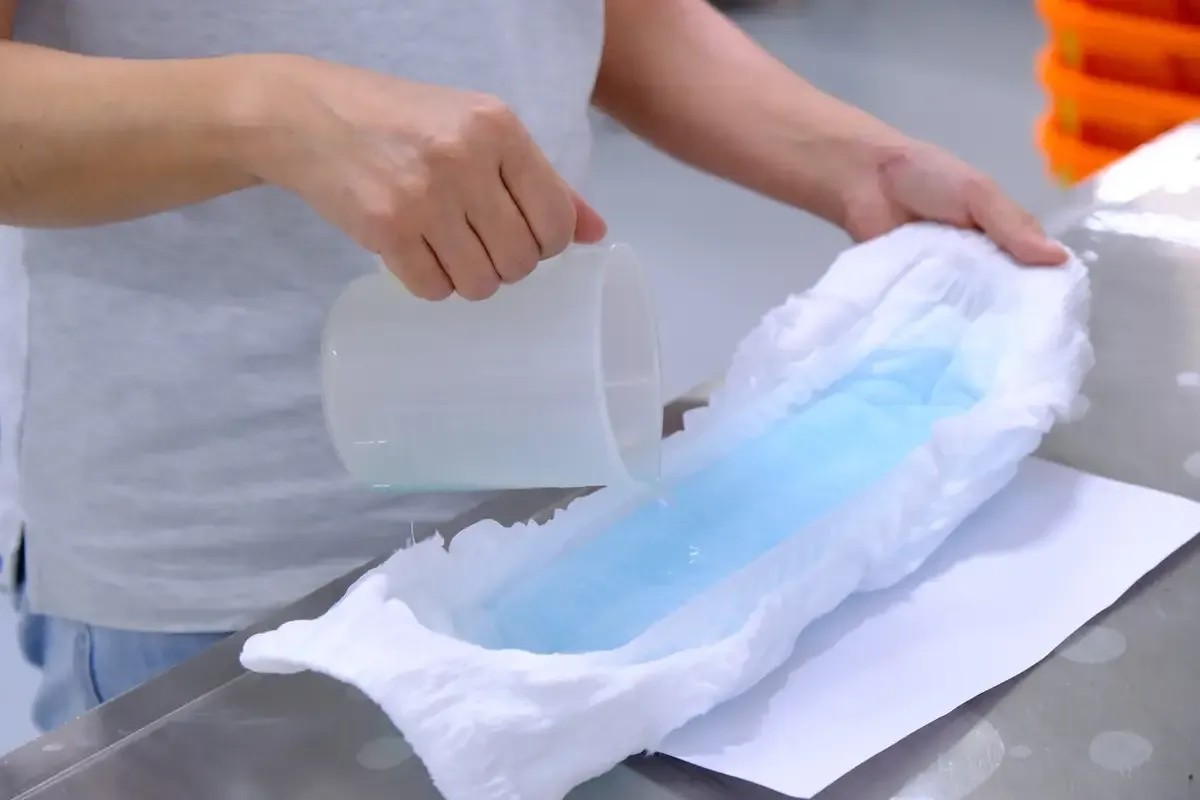
For a broader overview of inspection procedures and performance verification, see our article on adult diaper quality control and performance testing.
Developing Daytime and Overnight Products for Private Label Brands
A private label range usually works best as a paired specification rather than one core stretched across both use cases. Start with the change intervals the market expects, then set the absorbency, core geometry and containment targets for each product separately.
Sample testing follows, with each product evaluated against its own profile rather than a shared one. Packaging and pack counts then differ by use case: daytime products tend to sell in larger packs for routine replacement, overnight products in pack sizes that match less frequent change. SKU planning should reflect that, since two specifications double the size matrix before pack variants are added.
Easy Hygienic works with brand owners on both product types, covering absorbent core configuration, material selection, sizing and containment structure, with performance verified through laboratory testing and production quality control.
Adult Diaper FAQ
What is the main difference between daytime and overnight adult diapers?
The difference is the use condition, and the specification follows from it. Daytime adult diapers are designed around movement and a shorter change interval, so absorption speed, cuff behaviour during activity and discretion under clothing lead the design. Overnight products are designed around long static wear and loading by body weight, so retention under sustained pressure, lateral containment in side-lying positions and extended core coverage lead instead. Capacity is part of the difference, but core geometry and barrier design change as much.
Do overnight adult diapers always have higher absorbency?
Not necessarily. Overnight positioning usually calls for more capacity and stronger retention, but the actual values depend on the intended change interval, the channel and the test conditions used to verify them. A product can be built for overnight use with a moderate capacity and superior distribution and containment, while a daytime product in the same range may carry a higher headline capacity for a different reason. Comparisons are only meaningful when test conditions match.
Can OEM manufacturers customize adult diapers for overnight use?
Yes. Customization typically covers core length, width and weight, SAP and pulp ratio, acquisition layer design, leak guard height, cuff material, front and rear coverage, back sheet type and closure strength. Each change is then verified against the target use profile through retention, rewet and side-lying leakage testing before the sample is approved. Development usually starts from an existing platform so that tooling and material qualification stay manageable.
Conclusion
Daytime and overnight adult diapers are two specifications, not one product at two absorbency levels. Define the change interval, the wear condition and the channel first, then set absorbency, core geometry, containment and comfort targets and verify each of them with test data.
As an adult diaper OEM manufacturer, Easy Hygienic can review your daytime and overnight product positioning, absorbency requirements and target markets, and propose a development route covering core design, samples, testing and volume production. Contact us to start the discussion.