A baby diaper looks simple in appearance but is a sophisticated multi-layer hygiene product that combines premium baby diaper raw materials, precision mechanical processing, and standardized quality management.
For global brand owners, startup sellers, and cross-border buyers sourcing a reliable baby diaper manufacturer, unit price is never the sole evaluation standard. Professional buyers prioritize core factory capabilities, including standardized raw material supply, mature manufacturing processes, intelligent automation, and systematic quality control. These factors directly influence product safety, performance stability, delivery efficiency, and long-term brand credibility.
Many private label diaper brand setbacks result from partnering with factories with unstable supply chains and incomplete quality systems, causing inconsistent product quality, high defect rates, and compliance risks. To help global buyers better understand what happens behind the production line, this article takes you inside a modern baby diaper factory. We unpack the production workflow of custom baby diapers, from raw material selection and automated manufacturing to quality inspection and finished product delivery, while showing how Easy Hygienic manages production for OEM and private label customers.
Why Understanding the Manufacturing Process Matters for Buyers?
When working with a professional baby diaper factory, buyers are investing in manufacturing capability, production stability, quality management, and long-term supply reliability rather than simply purchasing finished products. Understanding how diapers are manufactured can help brands evaluate whether a production partner is equipped to support consistent quality and long-term business growth.
First, manufacturing processes directly influence product quality. Standardized and automated production lines minimize manual errors and help maintain batch-to-batch consistency, while outdated or fragmented processes may contribute to unstable absorption, leakage problems, and inconsistent wearing comfort.
Second, a mature manufacturing system supports flexible customization. Well-structured production processes allow manufacturers to adjust absorption performance, product sizes, structural components, and exterior designs, providing a foundation for differentiated private label baby diapers.
Third, standardized production management supports stable lead times and more controllable operating costs. Intelligent scheduling and automated operations improve production efficiency, reduce avoidable delays, and help brands manage their supply chain more effectively.
Raw Materials – The Building Blocks of a Baby Diaper
Premium baby diaper raw materials are fundamental to product safety, comfort, absorption, breathability, and leakage protection. Common materials used in our baby diaper production include non-woven fabric, breathable back film, super absorbent polymer, fluff pulp, elastic spandex, and hot melt adhesive.
Each material performs a specific function within the multi-layer diaper structure. Non-woven materials contribute to softness and skin contact, while super absorbent polymer and fluff pulp form the core absorption system. Breathable back film helps manage moisture and air permeability, while elastic components support fit and flexibility.
As an OEM baby diaper factory, Easy Hygienic applies supplier screening and regular material audits to its raw material sourcing process. We work with qualified suppliers and select materials according to product specifications, customization requirements, and applicable market standards.
For private label brands targeting different markets, material selection can be adjusted according to product positioning and performance requirements. This allows manufacturers to balance softness, absorption, breathability, fit, and other product characteristics within the intended specification.
How Baby Diapers Are Manufactured in a Modern Factory?
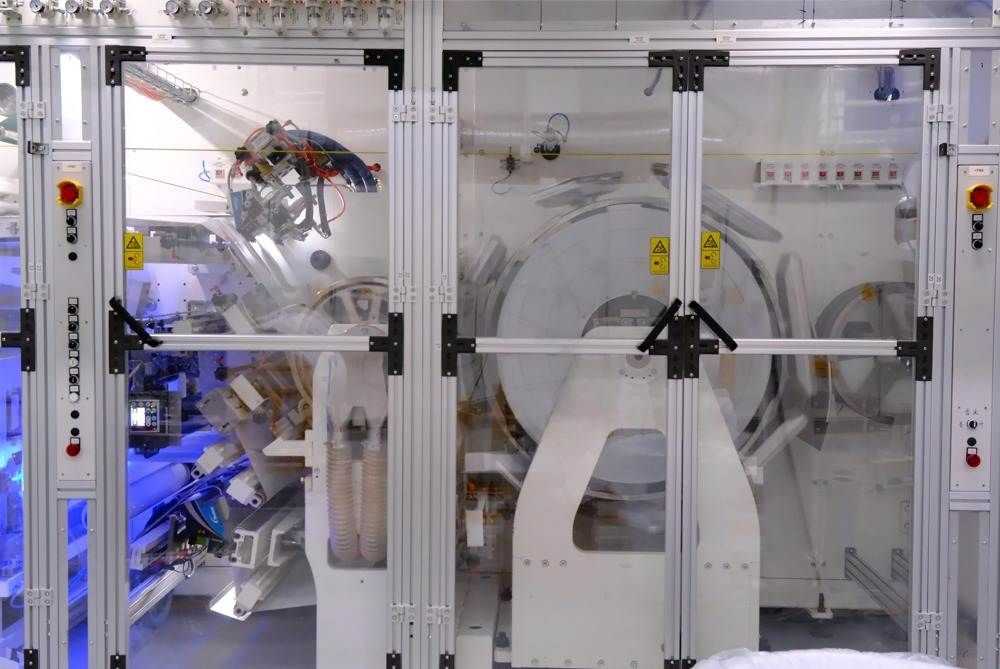
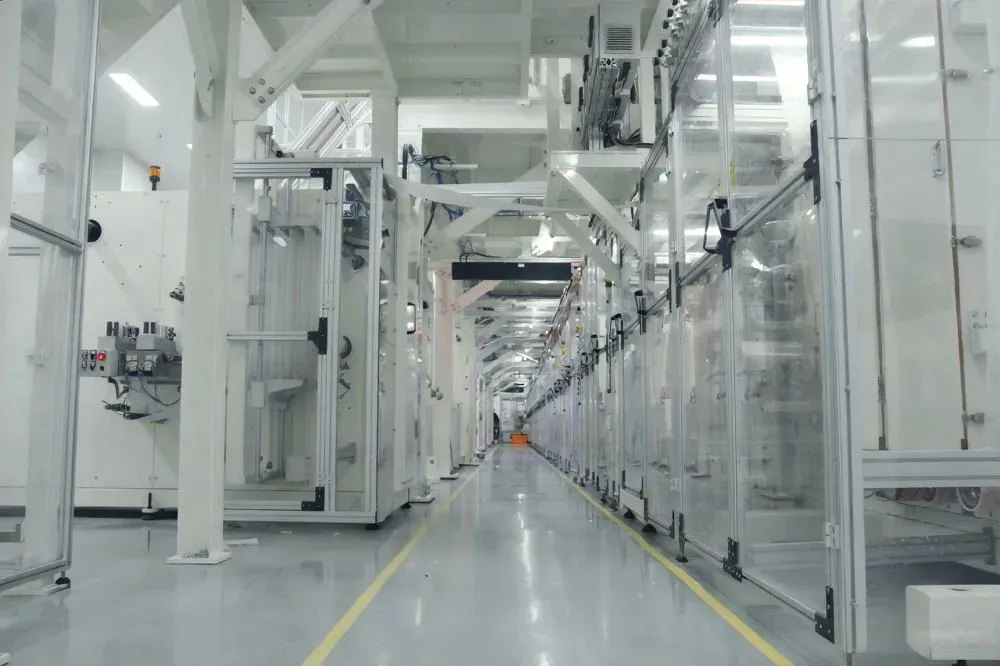
Modern baby diaper production involves multiple interconnected manufacturing stages. At Easy Hygienic, standardized production processes and automated equipment are used to improve consistency, efficiency, and production control.
Our manufacturing base is equipped with 35 automated production lines, a smart manufacturing system, and automated packaging equipment. These systems support stable production across different order volumes and product specifications.
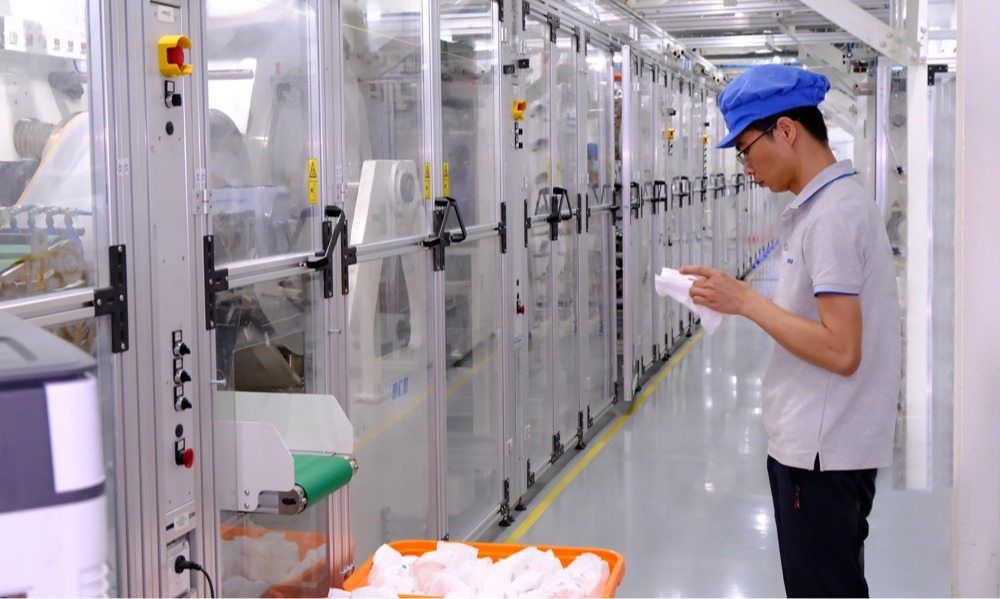
The production process begins with the accurate preparation and blending of raw materials according to the product formula. The absorbent core is then formed using specialized equipment designed to achieve consistent core structure and absorption performance.
Next, multiple material layers are laminated together. Non-woven fabric, breathable film, and functional core materials are precisely combined to create the main diaper structure. Elastic components are subsequently assembled, followed by precision cutting to maintain consistent product dimensions and specifications.
Throughout the production process, quality control is integrated directly into manufacturing. High-precision AI cameras conduct continuous online inspection to identify potential defects in real time. AGVs, robotic palletizing, MES, WMS, and digital QMS systems further support material handling, production scheduling, inventory management, and process traceability.
Once production is completed, qualified diapers move into automated packaging. The packaging process includes automatic counting, sealing, coding, and stacking. This integrated system allows the factory to support both customized trial orders and larger-scale production for private label brands.
How Quality Control Is Applied Throughout Production?
Quality control is an essential part of reliable baby diaper manufacturing. Product safety and performance depend not only on final inspection but also on quality management throughout the entire production process.
Easy Hygienic applies a three-stage quality inspection system designed to identify and control potential quality risks from incoming materials through finished products.
1. Incoming Raw Material Inspection
Before entering production, raw materials undergo inspection and sampling based on relevant quality requirements. Key characteristics such as safety, softness, absorption performance, and air permeability are evaluated according to material type and product specifications.
Materials that fail the required standards are rejected before entering production, helping prevent potential quality problems at the source.
2. Real-Time Online Production Inspection
During production, intelligent monitoring systems continuously inspect manufacturing processes. AI-based cameras can identify potential issues such as core deviation, missing components, and uneven adhesive application.
Easy Hygienic has established more than 350 quality checkpoints throughout production. Automated monitoring is combined with regular manual sampling to provide multiple layers of quality control and maintain consistency across production stages.
3. Finished Product Inspection
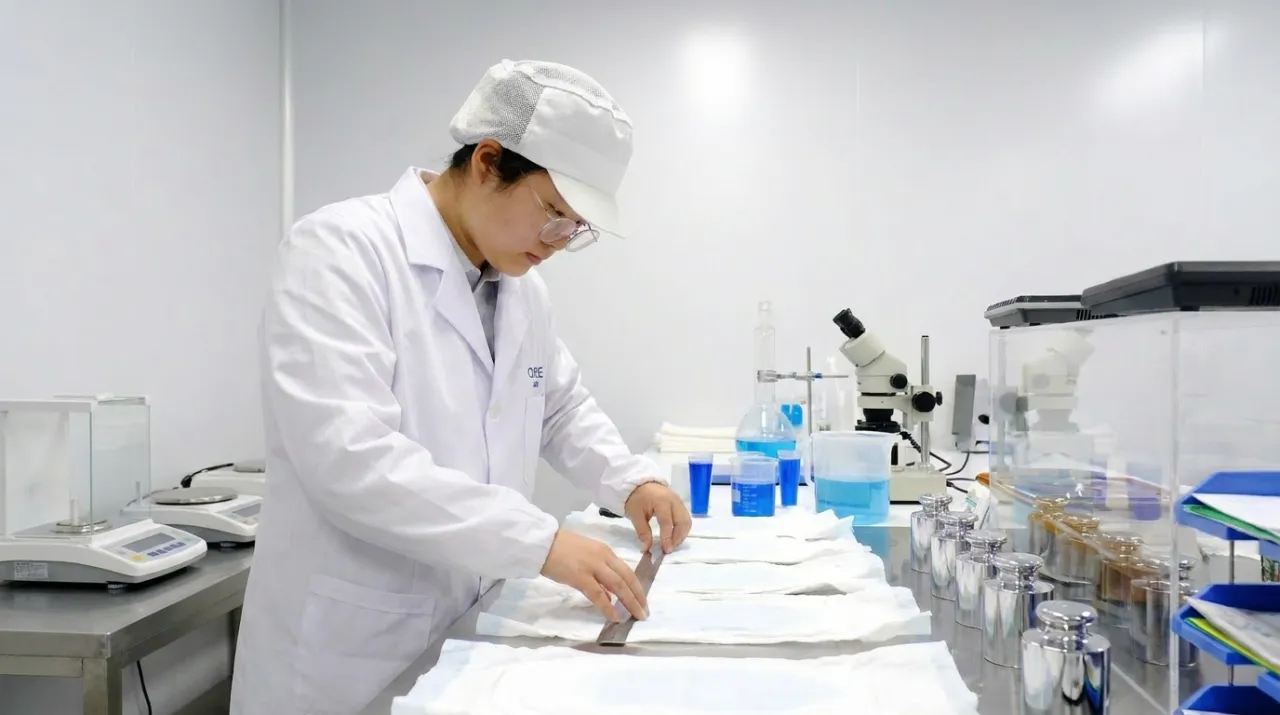
Before shipment, finished baby diapers undergo comprehensive inspection according to product requirements. Testing may cover absorption speed, rewet resistance, tensile strength, air permeability, appearance, and other relevant performance indicators.
Easy Hygienic also operates an independent CNAS testing laboratory to support professional product testing. Products that meet the applicable quality requirements can then proceed to packaging and shipment.
This full-process approach helps control defect rates and maintain stable product performance across different production batches.
Certifications That Matter for Global Baby Diaper Brands
For international brands, manufacturing capability needs to be supported by appropriate quality and compliance systems. Certifications can provide useful evidence when buyers evaluate a baby diaper factory and its ability to serve different markets.
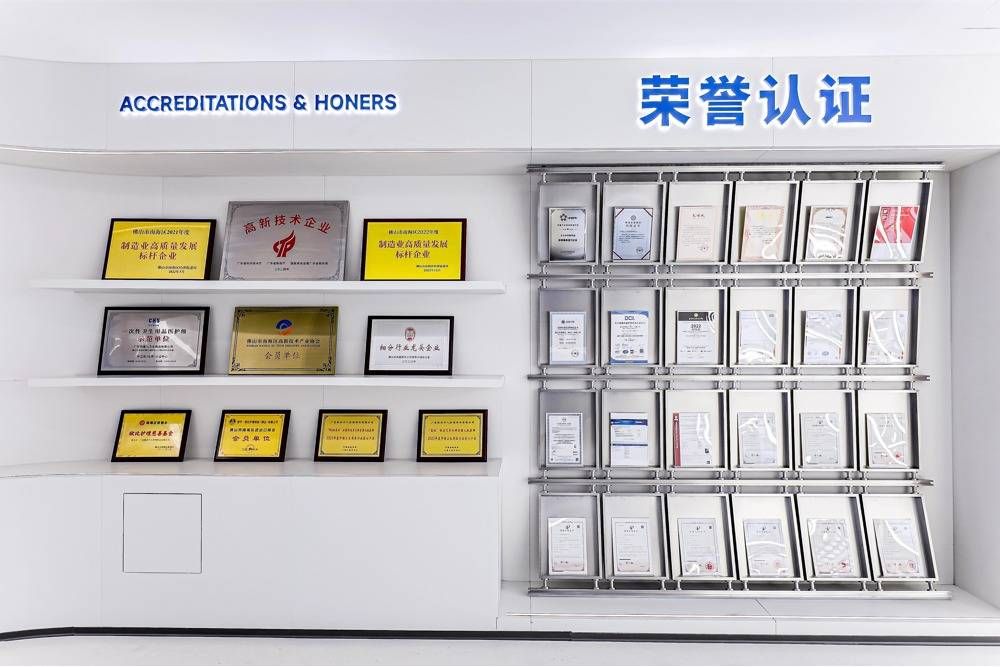
Relevant certifications and standards may include ISO 9001 quality management, ISO 13485, OEKO-TEX Standard 100, FDA-related requirements, and CE-related requirements, depending on the product and destination market.
ISO 9001 provides a framework for quality management and standardized operations. OEKO-TEX Standard 100 focuses on testing textile materials for harmful substances. Other certifications or market-access requirements may apply depending on the product category, claims, and target market.
Easy Hygienic maintains a range of international certifications and quality systems and provides compliance support according to customer and market requirements. For global private label brands, this helps create a more structured approach to product development, production, documentation, and market preparation.
How Manufacturing Process Directly Impacts Baby Diaper Quality and Cost Efficiency
Manufacturing processes have a direct impact on both product performance and production efficiency. For private label brands, understanding this relationship is important because the lowest initial unit price does not necessarily result in the lowest overall operating cost.
Precise core forming and lamination processes help maintain consistent absorption and rewet performance. Accurate component assembly supports stable fit and can reduce the risk of leakage-related product complaints.
Automation also reduces dependence on repetitive manual operations and helps maintain consistency across production batches. At the same time, optimized production processes can reduce material waste, improve labor efficiency, and shorten production time.
Full-process quality inspection provides another layer of cost control. Detecting defects during production rather than after shipment can reduce waste, returns, rework, and potential customer complaints.
For private label brands, these manufacturing efficiencies can contribute to more predictable product quality and supply-chain performance over the long term. These factors can also influence the overall investment required when launching a private label baby diaper brand. See our guide to private label baby diaper costs.
What to Look for in a Modern Baby Diaper Factory?
A modern baby diaper factory should offer more than production equipment alone. For brands planning long-term cooperation, several manufacturing capabilities are particularly important.
Production Capacity
Sufficient production capacity allows a factory to support different stages of brand growth, from initial trial orders to larger-scale production. A scalable production system also helps reduce supply risks when order volumes increase.
Quality Management
A structured quality system should cover raw materials, production processes, finished products, testing, and traceability. Multiple quality checkpoints and real-time inspection can provide stronger control than relying solely on final inspection.
Manufacturing Flexibility
Private label products often require adjustments to product structure, absorption performance, sizes, elastic components, or packaging. A flexible production system makes it easier to translate these specifications into consistent finished products.
Production Traceability
Digital production systems can improve visibility across materials, production scheduling, inventory, and quality records. Traceability is particularly valuable when brands need to investigate quality issues or maintain consistent production standards across multiple orders.
Compliance Support
International brands may face different requirements depending on their target markets. A factory with established quality systems, testing capabilities, and experience with international customers can provide stronger support during product development and market preparation. For buyers planning to source from China, our guide to importing baby diapers from China also covers supplier verification, MOQ, quality control, shipping terms, and other key sourcing considerations.
These capabilities together provide a clearer picture of a factory's actual manufacturing strength than unit price alone. If you are comparing potential manufacturers, our guide covers 7 questions to ask before choosing a baby diaper manufacturer.
How to Choose a Baby Diaper Manufacturer?
When sourcing a production partner for a private label business, buyers should evaluate the factory's overall manufacturing capability rather than focusing exclusively on quoted prices.
First, verify its production scale and output stability to determine whether it can support both initial trial orders and future volume growth.
Second, review its quality management system, testing capabilities, and relevant certifications. These factors provide insight into how consistently the factory can control product quality.
Third, confirm its customization capabilities. Discuss product structure, absorption requirements, sizes, waistband and leg cuff designs, functional features, and packaging before placing an order.
Finally, evaluate its experience working with international customers and its ability to support documentation, compliance, production coordination, and delivery.
A production partner with balanced manufacturing capacity, stable quality management, flexible customization, and appropriate compliance systems can provide a stronger foundation for long-term private label development.
How Easy Hygienic Supports Global Baby Diaper Brands?
Founded in 2012, Easy Hygienic has more than 14 years of experience in hygiene product manufacturing and provides OEM, ODM, and private label production services for global maternal and infant brands.
Our intelligent production base is equipped with 35 automated production lines, supporting both startup trial orders and larger-scale production requirements. Automated manufacturing and packaging systems help maintain consistent production across different product specifications.
Quality management is supported by an independent CNAS testing laboratory and more than 350 quality checkpoints throughout the production process. Our products have been supplied to more than 100 global clients, giving us experience in international production and cross-border cooperation.
We provide flexible MOQ solutions and support customization of core formulas, sizes, waistband designs, functional performance, and packaging. From product development and sampling to mass production, Easy Hygienic works with brands throughout the manufacturing process to develop customized baby diaper solutions.
FAQ
Q1: What raw materials are used in diaper manufacturing?
Baby diaper production commonly uses materials such as non-woven fabric, super absorbent polymer (SAP), fluff pulp, breathable PE film, elastic spandex, and hot melt adhesive. Material selection can be adjusted according to product specifications, customization requirements, and applicable market standards.
Q2: How long does OEM baby diaper production take from order to shipment?
Production time depends on factors such as order quantity, product specifications, customization requirements, and production scheduling. Standard customized orders generally follow established production schedules, while trial orders with specific requirements may require additional preparation. A confirmed production timeline should be provided based on the individual order.
Q3: What parts of baby diaper production can be customized for private label brands?
Private label baby diapers can be customized in areas such as absorption structure, product size, waistband and leg cuff design, functional features, materials, and packaging. The available customization level depends on product requirements, MOQ, and R&D capabilities.
Q4: What quality certifications should a diaper factory have?
Relevant certifications depend on the product and target market. Common quality and safety certifications or standards considered by international buyers include ISO 9001, ISO 13485, OEKO-TEX Standard 100, and applicable market-access requirements. Buyers should confirm that the factory's certifications and testing capabilities match their specific products and destination markets.
Conclusion
Reliable baby diaper production depends on more than individual materials or production equipment. High-quality raw materials, standardized manufacturing processes, intelligent automation, rigorous quality control, and appropriate compliance systems work together to determine product consistency and supply reliability.
For global private label brands, understanding how a baby diaper factory manages raw materials, production, testing, and quality control can provide valuable insight when evaluating potential manufacturing partners.
With more than 14 years of manufacturing experience, 35 automated production lines, an independent CNAS testing laboratory, 350+ quality checkpoints, and international quality systems, Easy Hygienic provides OEM, ODM, and private label manufacturing support for global baby diaper brands.
Looking for a reliable baby diaper factory for OEM or private label production?Contact Easy Hygienic to discuss product specifications, customization requirements, samples, and production solutions for your brand.