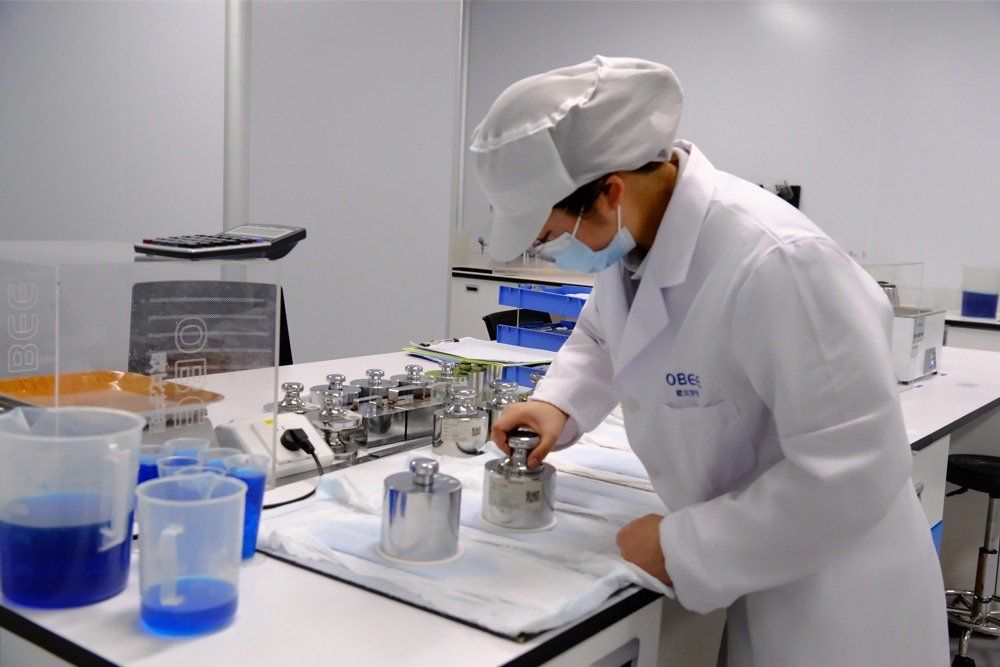
Buyers evaluating baby diaper samples often start with what they can see and touch: thickness, softness, material declarations or a manufacturer's specification sheet. These attributes matter, but none shows how a diaper performs once it is worn. Absorption speed, absorption capacity, rewet and leakage protection are functional properties that require controlled and repeatable testing.
For baby diaper brands and OEM buyers, understanding these performance indicators is essential when comparing samples and developing reliable product specifications. Explore our range of baby diaper products to understand the product categories and OEM customization options available for different market requirements. A diaper that looks thicker is not necessarily more absorbent, and a product with high absorption capacity may still perform poorly in terms of surface dryness or leakage protection.
This article explains how the main performance indicators are evaluated, how diaper construction influences test results, and how buyers can use testing data to make more informed sourcing and product development decisions.

Why Baby Diaper Performance Testing Matters for OEM Buyers
Baby diaper quality testing supports several stages of the product lifecycle, rather than serving as a single approval step.
During product development, objective test data helps determine whether changes to the absorbent core, acquisition distribution layer or raw materials improve actual performance. This allows brands to evaluate product improvements based on measurable results rather than relying entirely on sample appearance or subjective impressions.
During sourcing, a consistent diaper performance evaluation protocol makes it easier to compare products from different manufacturers. When each manufacturer uses different testing conditions, figures in separate reports may not be directly comparable. Applying the same agreed testing method gives buyers a more reliable basis for evaluating samples.
Before mass production, approved test results can become part of the product specification and quality acceptance criteria. During manufacturing, periodic inspections help confirm batch consistency and identify performance variations before finished products are shipped.
For OEM projects, performance testing therefore connects product design, sample approval and ongoing manufacturing quality.
Absorption Performance: Evaluating How Quickly and Effectively Diapers Absorb Liquid
Absorption is not a single measurement. A complete baby diaper absorption evaluation considers how quickly liquid enters the product, how much the diaper retains, how evenly liquid spreads and how the absorbent core behaves under pressure.
These indicators should be evaluated separately because they describe different aspects of product performance.
Absorption Speed
Absorption speed measures how long a fixed volume of test liquid takes to disappear from the diaper surface. A commonly used test liquid is 0.9% sodium chloride solution, intended to simulate certain properties of urine.
The liquid is applied at a defined position, and the time is recorded until no free liquid remains visible on the surface. The volume, dosing location and testing procedure should remain consistent when comparing samples.
Several structural factors influence absorption speed, including top sheet apertures, acquisition distribution layer (ADL) design and the balance between superabsorbent polymer (SAP) and fluff pulp.
However, faster initial absorption does not automatically mean better overall performance. If liquid is absorbed quickly in one localized area but does not distribute effectively through the core, some absorbent material may remain underutilized. This can also affect rewet performance.
Absorption Capacity
Absorption capacity describes how much liquid a diaper can take in and retain under specified test conditions.
Buyers may encounter measurements of free absorption capacity and liquid retention under compression. These measurements answer different questions. Free capacity evaluates liquid uptake without an applied load, while retention under pressure provides information about how well the absorbent structure holds liquid when compressed.
The difference between these values is particularly relevant when evaluating products intended for longer wearing periods.
Overnight diapers may require greater absorption capacity and stronger retention under pressure. Daytime products may place greater emphasis on rapid absorption, fit and overall comfort.
Capacity should not be considered in isolation. Excessive absorbent material can increase product thickness and affect flexibility, while a well-balanced core can achieve the required performance without unnecessary bulk.
Liquid Distribution
Liquid distribution describes how evenly fluid moves through the absorbent core after entering the diaper.
Poor distribution can cause liquid to accumulate in one area while other sections of the core remain relatively dry. This reduces the effective use of absorbent materials and may increase the possibility of leakage around the leg openings.
ADL length, fiber orientation, core layering and absorbent material distribution all influence liquid movement.
Wetting length and width can be used to describe the area reached by liquid during testing. These measurements help buyers understand whether the absorbent core distributes liquid effectively rather than concentrating it around the initial dosing point.
Absorbent Core Performance
The absorbent core combines materials with different functions.
Fluff pulp helps acquire and distribute liquid through the core, while SAP absorbs liquid and forms a gel that retains moisture. The balance between these materials, together with core architecture and SAP particle characteristics, influences the final performance.
A higher SAP proportion may support greater absorption capacity, but it does not automatically guarantee faster initial uptake. A pulp-heavy structure may support rapid liquid acquisition but may require careful evaluation of retention under compression.
Neither structure is universally better. The appropriate design depends on the target product specification, wearing requirements and intended market positioning.
For a closer look at how SAP, fluff pulp, nonwoven, ADL and backsheet materials influence diaper construction, see our guide to baby diaper raw materials.
Rewet Testing: Understanding Surface Wetness After Absorption
Rewet measures the amount of liquid that returns to the diaper surface when the absorbent core is subjected to pressure after liquid absorption.
It is an important indicator of surface dryness and helps buyers assess how well a diaper keeps moisture away from the baby's skin.
A diaper may absorb liquid quickly but still show relatively high rewet. This is because absorption and liquid retention are different performance characteristics.
How Is a Baby Diaper Rewet Test Conducted?
A typical rewet evaluation follows a controlled testing procedure:
- A defined volume of test solution is applied to the diaper.
- The sample is left for a specified resting period.
- Standard filter paper is placed over the designated test area.
- A specified weight is applied for a defined duration.
- The filter paper is weighed again to determine the amount of liquid transferred to it.
The weight gain of the filter paper represents the measured rewet value under the selected test conditions.
Several factors influence the result, including liquid volume, resting time, applied load, loading duration and filter paper characteristics.
Therefore, rewet values from different reports should only be compared when the testing methods and conditions are sufficiently consistent. A lower value generally indicates less liquid transfer under the specified conditions, but the test protocol must always be considered.
What Influences Rewet Performance?
Core construction is one of the main factors influencing rewet.
SAP helps retain absorbed liquid in gel form, while the ADL helps distribute liquid away from the surface. Top sheet characteristics also influence how moisture moves through the diaper structure.
A well-designed diaper needs to balance rapid liquid acquisition with effective retention. High absorption capacity alone does not guarantee low rewet.
For OEM buyers, absorption capacity and rewet should therefore be included as separate performance indicators when developing product specifications.
Leakage Protection Testing: Evaluating the Diaper's Structural Performance
Leakage is not determined by absorption capacity alone. It is also influenced by liquid distribution, product fit, leg cuff construction and the overall barrier design.
A baby diaper leakage evaluation should therefore consider how the product performs under different positions and controlled liquid dosing conditions.
Side Leakage
Side leakage is commonly associated with the performance of leg cuffs and the distribution of liquid inside the absorbent core.
A controlled test may position the sample at an angle to simulate a side-lying position. Test liquid is introduced at a defined rate, and the test area around the leg openings is observed for leakage.
Important structural factors include:
- Standing leak guard height
- Leg elastic tension and recovery
- Hydrophobic nonwoven materials used in the cuffs
- Core width and liquid distribution
- Overall diaper fit
A high-capacity absorbent core cannot compensate for poorly designed leakage barriers. If liquid reaches the leg openings faster than the core can acquire and distribute it, the barrier may be overwhelmed.
Front and Rear Leakage
Front and rear leakage evaluations consider how the diaper contains liquid around the waist and end sections.
The sample may be evaluated in supine and prone positions under defined testing conditions. Core length, waist fit, elastic recovery and end-barrier construction all influence performance.
If the waistband does not maintain an appropriate fit, gaps may develop during movement. Similarly, insufficient core coverage or poorly positioned barriers can increase the risk of leakage.
Effective leakage protection depends on the combined performance of absorbent materials, barrier construction and anatomical fit.
How Diaper Structure Influences Performance Test Results
Performance testing helps identify whether a diaper meets its functional requirements. Understanding the relationship between product construction and test results is equally important when developing an OEM product.
Different components contribute to different performance characteristics.
| Diaper Component | Main Function | Related Performance Indicators |
|---|---|---|
| Top Sheet | Allows liquid to pass through and provides the skin-contact surface | Absorption speed, surface dryness, softness |
| Acquisition Distribution Layer (ADL) | Acquires and distributes liquid through the core | Absorption speed, liquid distribution |
| Superabsorbent Polymer (SAP) | Absorbs and retains liquid | Absorption capacity, retention, rewet |
| Fluff Pulp | Helps acquire and distribute liquid | Absorption speed, liquid distribution |
| Leg Cuffs | Help prevent liquid from escaping around the leg openings | Side leakage protection |
| Back Sheet | Provides a liquid barrier and influences moisture vapor transmission | Leakage protection, breathability |
| Elastic Components | Help maintain fit around the waist and legs | Fit, leakage protection, dimensional stability |
These components work together rather than independently. Changing one material or structural feature can influence several performance indicators at the same time.
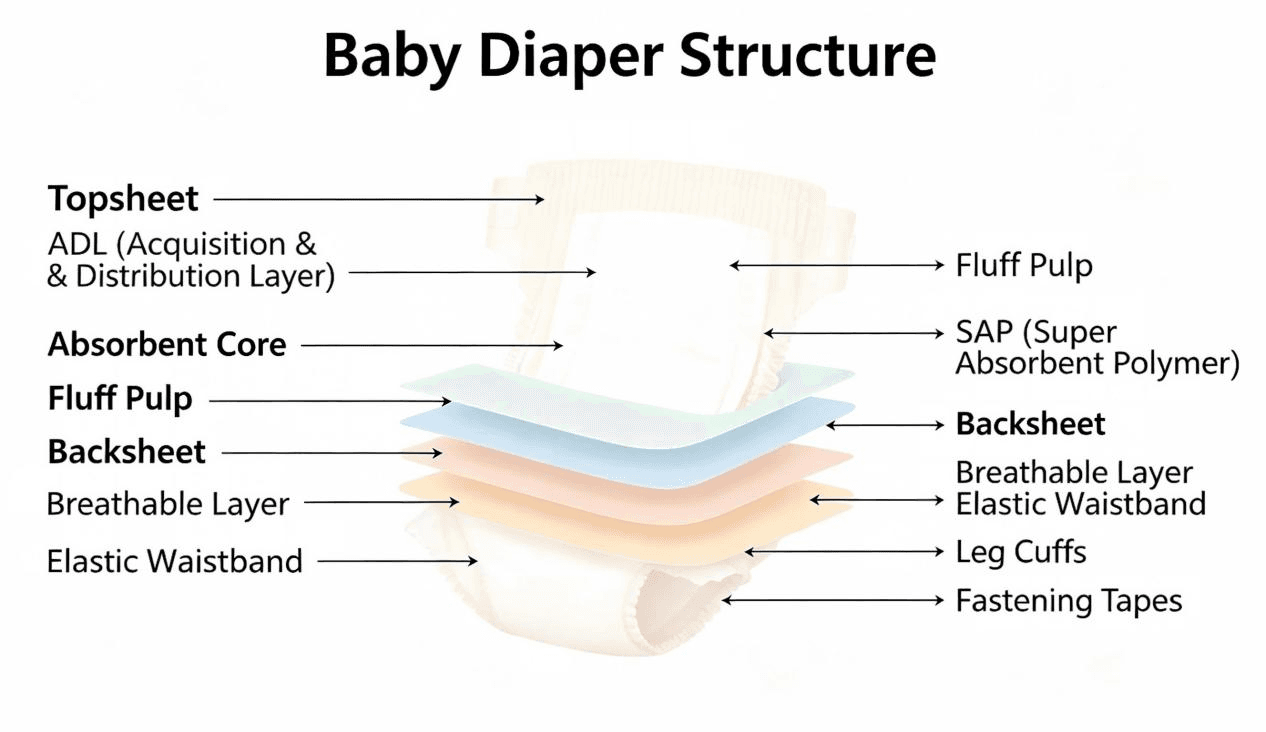
For example, adjusting the ADL may improve liquid distribution, while changing the SAP-to-fluff ratio can influence both absorption capacity and liquid retention.
For product developers and OEM buyers, performance testing should therefore be combined with an understanding of the diaper's construction. This makes it easier to identify the reasons behind test results and determine which design adjustments are appropriate.
Other Important Baby Diaper Performance Indicators
Although absorption, rewet and leakage protection are central performance indicators, other properties also influence product quality and user experience.
Softness and Skin-Contact Comfort
Top sheet softness influences how the diaper feels against the baby's skin. Material selection, fiber structure and surface characteristics all contribute to the overall tactile experience.
Softness can be evaluated through structured tactile assessments and appropriate friction testing methods.
Breathability
Breathability relates to the ability of moisture vapor to pass through the diaper's back sheet.
Moisture vapor transmission rate (MVTR) can be used to evaluate this property under defined temperature, humidity and testing conditions.
For product development, breathability should be considered alongside liquid barrier performance, since the back sheet needs to prevent liquid leakage while allowing an appropriate level of moisture vapor transmission.
Dimensional Stability
Dimensional stability describes how much the diaper changes shape after absorbing liquid.
Excessive swelling or deformation may affect the position of the waist and leg barriers, potentially influencing fit and leakage protection.
Elastic Recovery
Elastic recovery determines how effectively elastic components return toward their original dimensions after stretching.
Good recovery helps the diaper maintain a secure fit around the waist and legs during use.
Material Integrity
Material integrity refers to the ability of the diaper structure to remain intact during use.
Core breakage, absorbent material clumping and lint shedding can affect product consistency, comfort and perceived quality.
These indicators should be considered together with absorption and leakage data when evaluating the overall performance of a baby diaper.
Matching Performance Priorities to Different Baby Diaper Applications
Not every baby diaper needs the same performance profile. The appropriate balance depends on the intended product category, target consumers and market positioning.
| Product Application | Key Performance Priorities |
|---|---|
| Newborn Diapers | Softness, rapid absorption, low rewet and comfortable fit |
| Daytime Diapers | Absorption speed, fit, flexibility and leakage protection |
| Overnight Diapers | Absorption capacity, liquid retention under pressure and leakage protection |
| Premium Baby Diapers | Balanced absorption, surface dryness, softness and breathability |
These priorities are not universal pass-or-fail specifications. They provide a framework for discussing product requirements during OEM development.
For example, a brand developing an overnight diaper may place greater emphasis on retention under pressure and overall capacity. A newborn diaper project may give greater importance to softness, fit and surface dryness.
OEM buyers should define performance priorities before sample development so that manufacturers can evaluate suitable materials, structures and specifications.
How to Compare Baby Diaper Samples Using Consistent Test Conditions
Reliable baby diaper sample testing depends on consistent methods and controlled conditions.
Small differences in ambient conditions, dosing procedures or applied loads can influence test results. Comparing samples without controlling these variables may lead to misleading conclusions.
The following table summarizes the main performance indicators and their comparison principles.
| Test Item | What It Establishes | Typical Test Considerations | Comparison Principle |
|---|---|---|---|
| Absorption Speed | How quickly the surface clears after dosing | Test liquid, fixed volume and dosing location | Shorter time indicates faster initial uptake |
| Absorption Capacity | How much liquid the diaper absorbs and retains | Defined dosing or immersion procedure, with or without load | Higher retention may support longer wearing requirements |
| Rewet | How much liquid transfers back to the surface | Resting time, filter paper, applied load and duration | Lower values indicate less liquid transfer |
| Side Leakage | Performance of lateral leakage barriers | Sample position, dosing volume and rate | Leakage resistance under the specified conditions |
| Breathability | Moisture vapor transmission | Temperature, humidity and sample area | Higher transmission indicates greater moisture vapor passage |
For a meaningful comparison, samples should be conditioned under the same environmental conditions and evaluated using the same testing protocol.
Ideally, competing samples should be tested in one laboratory under the same conditions rather than compared through reports prepared using different methods.
An evaluation sheet should record:
- Sample identity, product size and production date
- Batch number and product specification
- Absorbent core construction and SAP loading, where available
- Test method and reference
- Testing conditions and equipment
- Measured results and units
- Agreed acceptance criteria and pass-or-fail status
This information helps buyers understand not only which sample performs better, but also why the differences may occur.
For a practical framework covering product format, size, materials, absorbency, fit and packaging requirements, refer to our guide to baby diaper OEM specifications.
From Laboratory Testing to Mass Production Quality Assurance
Laboratory results establish product performance benchmarks. Manufacturing quality systems help ensure that approved specifications can be maintained during mass production.
As a baby diaper manufacturer, Easy Hygienic connects product testing with manufacturing quality control.
Easy Hygienic operates a 1,600 m² laboratory holding CNAS accreditation for defined test items in disposable hygiene products. Its testing activities cover incoming material evaluation, absorbent core and structural verification, and finished product validation.

CNAS accreditation is scope-based. Buyers can request the relevant accreditation certificate and scope schedule to verify which testing methods are covered. Not every internal test is necessarily included in the accredited scope.
More information about the company's quality management and certifications is available on the Quality & Certifications page.
During manufacturing, 350+ QC checkpoints cover incoming materials, production processes and finished products. AI-based camera inspection supports the detection of dimensional and structural defects on production lines.
Together with batch records and traceability, these measures help connect laboratory evaluation with routine manufacturing quality control.
For OEM buyers, this connection matters because approving a sample is only the beginning. The manufacturing process must also be capable of maintaining the agreed product specifications across production batches.
What OEM Buyers Should Request When Reviewing Diaper Test Results
A baby diaper testing report should provide enough information for buyers to understand the testing method, reproduce the evaluation and connect the results to the actual product specification.
Before approving a sample, OEM buyers should review several essential details.
1. Test Method Reference
Confirm whether the test follows a recognized industry standard or an agreed internal testing protocol.
The method reference is essential because two reports may use different procedures even when they measure the same performance indicator.
2. Testing Conditions
Review the conditions used for each test, including:
- Ambient temperature and humidity
- Test solution concentration
- Liquid volume and dosing position
- Applied load and loading duration
- Resting time before measurement
- Filter paper or other testing materials, where applicable
A report that omits important testing conditions may be difficult to reproduce or compare.
3. Sample Identification
The report should identify the product being evaluated, including its specification, size, production date and batch number.
This information helps confirm that the tested sample corresponds to the product being offered for production.
4. Replicate Results and Acceptance Criteria
Where appropriate, buyers should request replicate measurements rather than relying on a single test result.
Results should be compared against the agreed product specification and acceptance criteria. Buyers should also understand whether reported figures represent individual measurements, averages or other calculated values.
5. Laboratory Qualification and Traceability
Finally, buyers should review the laboratory's relevant qualifications, testing scope and record-keeping procedures.
For OEM projects, a complete testing report should support both sample approval and subsequent quality verification during mass production.
Baby Diaper Performance Testing FAQ
Q1:What are the most important performance tests for baby diapers?
The three main performance groups are absorption, rewet and leakage protection.
Absorption testing evaluates how quickly and how much liquid the product handles. Rewet testing measures the amount of liquid transferred back to the surface under pressure. Leakage testing evaluates how effectively the diaper structure contains liquid under specified conditions.
Breathability, softness and material integrity are also important because they contribute to comfort and overall product quality.
Q2:What is the difference between absorption capacity and rewet?
Absorption capacity describes how much liquid a diaper can absorb and retain under specified conditions.
Rewet measures the amount of liquid that returns to the surface when the absorbent core is compressed.
The two indicators evaluate different properties. A diaper with high absorption capacity may still show relatively high rewet if its core does not retain liquid effectively under pressure.
Q3:How can OEM buyers compare baby diaper samples?
OEM buyers should first establish a shared testing protocol and ensure that samples are evaluated under consistent environmental and testing conditions.
They should then record each sample's size, product specification, core construction and relevant test results.
Finally, samples should be compared across multiple performance indicators rather than ranked according to a single measurement. Daytime, overnight and premium products may have different performance priorities.
Q4:What should OEM buyers look for in a baby diaper testing report?
A useful testing report should include the test method, testing conditions, sample identity, measured results, units and agreed acceptance criteria.
Buyers should also review replicate results where appropriate, together with laboratory qualifications and batch traceability information.
Without these details, it may be difficult to verify the results or compare products from different manufacturers.
Conclusion
Baby diaper quality cannot be judged reliably through appearance, thickness or a manufacturer's description alone. Standardized and repeatable performance testing provides a more objective way to evaluate absorption speed, absorption capacity, rewet and leakage protection.
For OEM buyers, the most useful approach is to combine testing data with an understanding of diaper construction, product positioning and manufacturing quality assurance. A consistent evaluation protocol, complete test records and clearly defined acceptance criteria provide a stronger basis for sample approval and long-term sourcing decisions.
As an experienced baby diaper OEM manufacturer, Easy Hygienic supports product development, sample evaluation, specification alignment and volume manufacturing within an integrated quality management system.
For brand owners and procurement teams developing a private label baby diaper range, share your target product positioning, size range and performance requirements with our team. We can discuss suitable product structures, testing priorities and manufacturing options for your project.
Contact Easy Hygienic to discuss your baby diaper OEM project.